City, in Places
Arakcadia
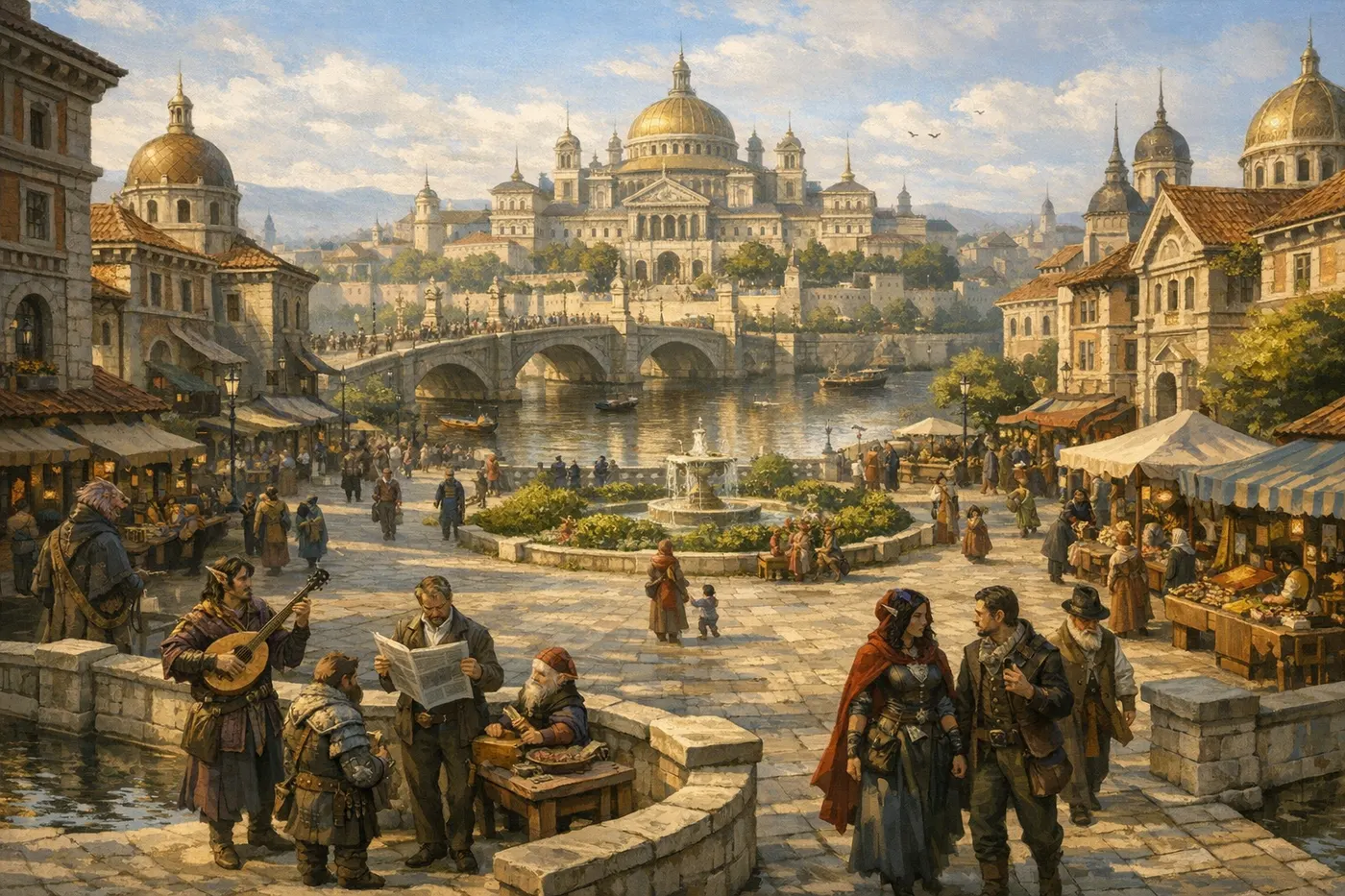
Arakcadia is a major city-state in central Canaan, located at the absolute eastern point of Arakcadia Bay in the Mediata Savannah. Built around the Emerald River, which flows through the city and into The Jade Oasis, Arakcadia is one of the continent’s principal centres of trade, education, diplomacy, public administration, scholarship, and cartography. Its position at the meeting point of bay traffic, river transport, canal movement, and overland roads has made it the foremost urban power of the Mediata Savannah and the permanent seat of the Arakcadian Congress.
Arakcadia is widely regarded as a bastion of progress and civic opportunity. Its public identity is founded on peace, education, meritocratic governance, lawful procedure, and the belief that knowledge should be made useful to the citizenry. All Arakcadian citizens are entitled to education, a principle regarded as one of the city-state’s defining achievements and one of the clearest expressions of its founding purpose. The city’s official languages are Common and Mediatan, while Zilaphelian, Elvish, and Dwarvish are recognised due to Arakcadia’s diplomatic, scholarly, and commercial connections.
The city is governed as a representative meritocracy by the Arakcadian Council, seated at The Kamatel on the northern bank of the Emerald River. The current First Speaker is Madame Elspeth Tremzume. The wider Arakcadian Congress is represented through the Congress Assembly, which brings delegates from allied settlements across the Mediata Savannah. Arakcadia’s political culture is generally characterised by calm diplomacy, institutional caution, civic documentation, and a preference for formal process over personal rule.
Although Arakcadia is associated with openness and scholarship, its public institutions also exercise careful control over dangerous knowledge, especially material relating to advanced magic, unstable artefacts, and sensitive state security. This policy is officially regarded as a civic safeguard, intended to preserve public order and prevent the abuses that once led to the Millenia of Darkness. For this reason, Arakcadia’s reputation is twofold: it is one of the most learned places in Canaan, but also one of the most careful about what knowledge is placed into general circulation.
Etymology
The origin of the name Arakcadia is disputed. Linguists of the Arakcadian Institute of Linguistic Studies most often derive it from the ancient Mediatan root ara-, “to open”, giving a sense of “opening” or “gateway” fitting for a port that joins distant regions. An older tradition reads it instead as the Xeamian Arak-Kadia, “harbour of return”, and a popular civic story traces it to two figures of the early trade post, Tovren Arak and Sairen Kadia. Whatever its origin, the name was first associated with the bay’s eastern trade post and later with the city that developed there.
The modern name Arakcadia Bay is the standard civic, cartographic, diplomatic, and Common-language name for the great inland body of water at the centre of Canaan. Older religious and literary names remain in use in particular contexts. In Uinheit tradition, the bay is sometimes called The Child’s Basin, referring to the belief that the Child of the Seas formed the bay as a divine pool. A poetic variant, The Cradle of Waters, appears in temple verse and older literary works.
The demonym is Arakcadian. The adjective is used for the city, its people, its government, its institutions, and its wider civic sphere, including the Arakcadian Council, Arakcadian Civic Time, Arakcadian Cartographic Office, and Arakcadian Royal Library Press.
Geography
Site
Arakcadia stands at the absolute eastern point of Arakcadia Bay, where the city’s river system, harbour approaches, and overland roads meet. The city is built around the Emerald River, a major waterway flowing through Arakcadia and into The Jade Oasis. The river forms the principal division between the northern and southern banks of the city and has shaped Arakcadia’s transport, districts, wealth, defensive geography, and civic identity.
The surrounding region is part of the Mediata Savannah, a broad expanse of grasslands, river corridors, farms, small settlements, and trade roads. Arakcadia occupies one of the most favourable positions in this landscape. It has access to the bay, river, roads, and nearby oasis systems, allowing it to operate as both a port and an inland capital.
Soils
The soils of the Arakcadia area are characteristic of the eastern bay margin. Arlak Silt covers the upper farmland zone: a loamy, reddish-brown soil well-suited to agriculture. Beneath and beyond the farmland, Arakcadian Ironclay — a dense clay that hardens in the basin — underlies much of the settled ground and presents particular challenges for construction and drainage.
Fauna
Notable animals of the Arakcadia region include Savannah Striders, large creatures used as mounts across the Mediata Savannah; Dusk-Wing Grouse, a common bird of the grasslands; Rivermouth Crocodiles, found along the lower Emerald River and bay margins; and Ironclay Scuttlers, a nuisance creature that burrows into Ironclay foundations and is known to undermine building structures.
Arakcadia Bay
Arakcadia Bay is one of the defining geographical features of Canaan. It cuts into the centre of the continent and forms the natural heart of the Mediata Savannah. Its waters carry ships, ferries, fishing vessels, diplomatic craft, merchant traffic, and local boats. Its eastern extremity is occupied by Arakcadia itself, giving the city a natural role as a commercial terminus and administrative centre.
The bay moderates Arakcadia’s climate, supports its harbour economy, and connects the city to island communities and other coastal settlements. It is often treated not merely as a body of water but as the geographical reason for Arakcadia’s existence. The city’s oldest trade functions were tied to shipping, and its later political power developed from the same advantage.
The Emerald River and The Jade Oasis
The Emerald River is one of Arakcadia’s principal natural features. It flows through the city and into The Jade Oasis, providing a major river corridor for transport, water management, trade, and settlement. Within the city, the river supports canals, bridges, wharves, water taxis, riverfront housing, and the civic division between the north and south banks.
The Jade Oasis lies inland from Arakcadia and is closely tied to the city’s eastern water geography. The Emerald River’s flow into the oasis gives Arakcadia a rare position between bay and oasis, strengthening its role as a mediator between maritime and inland systems.
Climate
Arakcadia has a bay-moderated savannah climate. The wider Mediata Savannah is shaped by alternating wet and dry periods, with Poorneet bringing heavy rains, green grasslands, full river channels, and intense storms. During the drier seasons, particularly Biderap and Garrawang, the surrounding grasslands become hotter, paler, and more vulnerable to fire.
The city’s position near Arakcadia Bay softens these extremes. The water moderates daily temperatures, increases humidity, and contributes to morning fogs in cooler periods. Arakcadia is generally more humid and temperate than settlements farther inland, though it remains part of the central savannah climate system.
The Itumue Mountains and northern highlands influence broader regional winds and storm systems. Arakcadia is better protected than many exposed settlements, but its harbour, canals, and riverbanks require constant maintenance against seasonal flooding, silt, and storm runoff.
Aywin Islands
The Aywin Islands lie within Arakcadia Bay. They are independent, having previously been contested, but are now under Arakcadian protection. Access to the islands is heavily restricted.
The islands’ protected status reflects their strategic importance within the bay and the sensitivity of their communities, ecology, and political history. In ordinary public understanding, Aywin is not considered part of Arakcadia proper. It is instead an independent island territory under Arakcadian protection and subject to strict movement controls.
Roads and transport
Arakcadia’s streets follow the logic of a city that grew from a shipping post into a civic capital rather than one planned all at once. The oldest routes run between the harbour, river crossings, gates, markets, and storehouses. Later civic roads were cut more deliberately toward the Kamatel, the Highriver District, the Great Library, and other north-bank institutions. As a result, the south bank is denser and more irregular, while the north bank is more formal, spacious, and controlled.
Movement through Arakcadia is rarely purely by road. Most residents combine walking, carts, bridges, ferries, canal boats, and water taxis depending on district, cargo, class, and urgency. A clerk travelling from Rivergate to the Great Library might walk to a canal stop, cross by water, and climb the north-bank streets. A dockworker might never need to cross the river at all. A diplomat may travel by carriage through formal approaches, while a market trader may move goods by handcart in the morning and by canal barge in the afternoon.
The city’s transport logic is shaped by three pressures: the bay pulls trade toward the Docklands; the Emerald River divides civic authority between south and north; and the Bronze Track pushes overland traffic through the gates and markets. Visitors who try to navigate Arakcadia like a simple walled city usually become lost quickly. Locals instead think in terms of banks, bridges, gates, canal stops, plazas, and landmarks.
Bronze Track
The Bronze Track is the main overland road associated with Arakcadia and one of the most important routes in the Mediata Savannah. It threads through the city and connects Arakcadia with settlements to the south, as well as with branching roads leading toward the eastern mountains, the southern borderlands, and other central towns.
The Bronze Track carries merchants, travellers, officials, pilgrims, scholars, guards, messengers, and caravans. Its passage through Arakcadia reinforces the city’s role as a continental crossroads rather than a purely maritime port.
River and canal transport
The Emerald River and the city’s canal system are central to Arakcadian movement. Canals connect districts, markets, civic buildings, and harbour areas, allowing people and goods to cross the city without relying entirely on roads. Water taxis are common, and many districts are understood as much by their river and canal access as by their street layout.
This system makes Arakcadia one of the most water-oriented cities in Canaan. Its bridges, quays, canal steps, riverside taverns, and ferry points are ordinary features of civic life. Among these crossings is a notably tall bridge spanning the Emerald River between the city's two banks, connecting the north and south sides of Arakcadia high above the water.
Harbour and shipping
Arakcadia’s harbour developed from its original role as a trade post, especially for shipping. Over time, this harbour function expanded into a full dockland economy of piers, warehouses, ship services, fish markets, street vendors, customs officials, cargo handlers, ferries, and bay traffic.
Ships arrive from around Arakcadia Bay and from wider maritime routes. Trade with Droshdech, the western bay settlements, the northern coast, and island communities contributes to the city’s wealth and cosmopolitan character.
Gates
Arakcadia has multiple city gates. Eastgate is one of the older and better-known gates, marking a transition from suburban approaches into the denser and older inner city. It is not the only gate, but it remains an important landmark in descriptions of the city’s urban form.
The city’s gates serve practical, defensive, symbolic, and administrative purposes. They allow inspection of travellers, regulate cart traffic, and reinforce the distinction between Arakcadia proper and the surrounding lands of Greater Arakcadia.
History
Early settlement
Arakcadia was first settled in 2 AP, during the early Age of Peace. The original settlement was a trade post, especially concerned with shipping. Its position at the eastern point of Arakcadia Bay made it an obvious place for merchants, boatmen, river traders, and overland travellers to meet.
The early trade post likely served several overlapping functions: harbour landing, river crossing, storage point, repair stop, marketplace, and communication link between bay settlements and inland routes. Its growth was gradual, shaped less by conquest than by the ordinary accumulation of trade, trust, and useful geography.
Founding of the Council
Arakcadia was formally founded in 264 AP, when the city’s council was created. This date marks the beginning of Arakcadia as an organised civic polity rather than merely a settlement or trade post.
The foundation of the council is treated in Arakcadian civic history as a decisive moment. It established the principle that the city should be governed by public deliberation, institutional competence, and service to the common good. Later Arakcadian political traditions, including the representative meritocracy, trace their legitimacy to this act of council formation.
Age of Peace
During the Age of Peace, Canaan was shaped by the old imperial systems of the Xeamian Empire and Zawma Empire. Arakcadia’s location placed it within the Xeamian cultural sphere, but its trade connections also exposed it to northern, island, savannah, elven, and dwarven influences.
The later Xeamian-Zawma Conflict destroyed the old imperial order and left much of Canaan politically reorganised. Arakcadia’s survival and growth after this period depended on its ability to serve as neutral ground between successor powers, regional communities, and emerging states.
New Age development
In the New Age, Arakcadia became the leading city of the Mediata Savannah and the seat of the Arakcadian Congress. It developed from a trade city into a political, scholarly, and diplomatic capital.
Its expansion produced a layered urban structure: old gates and stone districts, southern commercial quarters, northern civic and elite precincts, riverside suburbs, bayfront docks, and farmlands beyond the city proper. The city’s growth was tied to public education, bureaucratic administration, maritime commerce, and institutional scholarship.
Government and politics
Two-level civic system
Arakcadia is governed through a two-level civic system. Arakcadia proper is administered by the Arakcadian Council, led by the First Speaker, while the wider Arakcadian Congress is represented through the Congress Assembly of delegates from member settlements. The Council governs the city and its suburbs; the Congress coordinates shared regional matters across the Mediata Savannah.
Sensitive or urgent business is handled by the High Council, while everyday administration is carried out by specialised civic offices and bureaus. The system reflects Arakcadia’s core political ideal: public voice, demonstrated competence, and institutional service are all legitimate sources of civic authority.
Representative meritocracy
Arakcadia is governed as a representative meritocracy. In broad terms, this means that civic responsibility is publicly understood to belong to those who have demonstrated skill, service, learning, judgement, or other recognised forms of merit. The system is contrasted with hereditary monarchy and direct imperial command.
In public Arakcadian political language, authority is expected to arise from education, office, civic standing, and proven contribution to the common good. The city is not governed by birthright, but neither is it governed by popularity alone.
Arakcadian Council
The Arakcadian Council is the governing body of Arakcadia proper. It was created in 264 AP and remains the central institution of Arakcadian government. The Council administers law, public works, education, diplomacy, trade regulation, security, records, civic appointments, and relations with Congress-aligned settlements.
The Council is composed of three kinds of members: District Councillors, Senior Civic Officers, and Merit Appointees.
| Council member type | Function |
|---|---|
| District Councillors | Elected representatives of recognised districts and suburbs of Arakcadia proper. |
| Senior Civic Officers | Heads of major civic offices who sit on the Council because their offices affect city governance. |
| Merit Appointees | Specialists selected for recognised expertise in fields vital to the city, such as law, engineering, medicine, scholarship, diplomacy, navigation, defence, commerce, or controlled historical research. |
Arakcadian political culture strongly favours procedure. Petitions, appointments, hearings, warrants, permits, written orders, and office protocols are normal features of government. This gives Arakcadia a reputation for stability, predictability, and lawful process.
Selection and civic rolls
District Councillors are elected by citizens on the civic roll of each district. Voting is broad and based on adult citizenship, completion of basic civic education, and good civic standing. It is not formally restricted by wealth, ancestry, sex, or property.
Candidates for district office are expected to meet stronger civic qualifications. These include advanced civic education, legal and civic literacy, residency or substantial work in the district, local nominations, and disclosure of major conflicts of interest, debts, commercial holdings, guild offices, and foreign ties.
Senior Civic Officers rise through the civic service. They are nominated by their offices, reviewed by an appointments board, and confirmed by the Arakcadian Council. Once confirmed, they hold office subject to review, retirement, resignation, misconduct, or incapacity.
Merit Appointees are nominated by recognised institutions, guilds, courts, academies, civic offices, or scholarly bodies and confirmed for fixed terms. This allows the Council to draw on specialist knowledge without making every form of authority directly electoral.
First Speaker and Second Speaker
The head of Arakcadia’s government is the First Speaker, currently Madame Elspeth Tremzume. The title reflects Arakcadia’s council tradition and the idea that leadership should proceed from civic deliberation rather than personal sovereignty.
The First Speaker is chosen by the Arakcadian Council from among its members and affirmed by the Congress Assembly. The office carries significant diplomatic, ceremonial, and emergency authority, but it is not monarchical and cannot govern independently of the Council.
The Second Speaker is the deputy presiding officer of the Arakcadian Council. The Second Speaker chairs ordinary sessions when the First Speaker is absent, oversees procedural continuity, and may temporarily assume the First Speaker’s duties during incapacity or emergency.
High Council
The High Council is a smaller senior committee drawn from the Arakcadian Council and senior civic offices. It is not separately elected. It handles sensitive, restricted, or urgent business that cannot easily be managed by the full Council in ordinary session.
The High Council may act in emergencies, especially in matters of foreign accord, public order, restricted knowledge, harbour safety, Congress security, plague response, invasion, piracy, or major magical threat. Its emergency directives must later be recorded and reviewed.
Civic offices and bureaus
Daily administration is carried out through specialised civic offices and bureaus. Their senior officers sit within or report directly to the Arakcadian Council.
Major civic offices include:
| Office / bureau | Primary responsibilities |
|---|---|
| Office of Roads and Measures | Roads, bridges, official distances, weights, measures, surveys, and route standards. |
| Harbour and Bay Office | Docks, ships, ferries, customs, bay navigation, harbour safety, and restricted waters. |
| Office of Civic Education | Schools, public education, examinations, civic instruction, and education standards. |
| Office of Archives and Review | Public records, historical review, publication review, restricted documents, and responsible stewardship of dangerous knowledge. |
| Office of Public Works | Canals, drainage, walls, gates, public buildings, civic maintenance, and city infrastructure. |
| Office of Civic Peace | City guard, public order, gate security, patrol standards, and internal safety. |
| Office of Congress Affairs | Communication with member towns, Congress delegates, civic levies, and inter-settlement administration. |
| Office of Foreign Accord | Diplomacy with Zilaphela, Veurim, Droshdech, Aywin, and other external powers. |
| Office of Health and Sanitation | Plague response, sewers, hospitals, clean water, food safety, and public health. |
Civic titles
Arakcadian political language deliberately avoids royal and aristocratic titles. The city-state is led by the First Speaker, assisted by the Second Speaker. Members of the Arakcadian Council are known as Councillors, while representatives from member settlements of the wider Congress are Congress Delegates. Foreign representatives are styled Envoys.
Senior administrators are Civic Officers, normally named by function, such as the Civic Officer for Harbour and Bay or the Civic Officer for Archives and Review. Security and enforcement officials generally use practical titles such as Warden, Captain, and Peace Officer. The language of government is intentionally civic rather than noble, reflecting Arakcadia’s rejection of hereditary authority.
Arakcadian Congress
The Arakcadian Congress is a civic commonwealth of allied towns, cities, and protected settlements across the Mediata Savannah. It is centred on Arakcadia, which serves as its permanent capital, largest city, chief harbour, and administrative seat.
The Congress is neither a monarchy nor an empire. Member settlements retain their own councils, guards, customs, and internal laws, but cooperate under Arakcadian leadership in matters of diplomacy, trade, road maintenance, bay navigation, education standards, defence coordination, inter-settlement law, and official records.
Most major settlements of the Mediata Savannah belong to the Congress, though some frontier communities are only loosely affiliated. Member towns contribute civic levies toward shared roads, schools, archives, harbour systems, patrols, and emergency defence. They also send delegates to Congress sessions in Arakcadia, separate from the councillors who govern Arakcadia proper.
Arakcadia’s authority over member settlements is limited but significant. It does not normally govern local markets, festivals, guards, or minor law, but it may intervene under agreed emergency or treaty conditions, including piracy, plague, invasion, major magical threat, unlawful slavery, inter-town violence, or breach of Congress law.
Foreign relations
Zilaphelian Kingdom
Arakcadia maintains an important alliance with the Zilaphelian Kingdom. The relationship is shaped by trade, diplomacy, scholarship, security, and geography. Zilaphelian is a recognised language in Arakcadia, and northern officials, merchants, scholars, and travellers are a familiar presence in the city.
The relationship is sometimes described as healthy but commanding. Zilaphela is a powerful kingdom with its own ambitions and customs, while Arakcadia is a civic and diplomatic power built around negotiation and administrative balance.
Droshdech
Droshdech maintains friendly relations and strong trade ties with Arakcadia, though the two are not formally allied. As an independent island nation, Droshdech is an important maritime partner and a significant point of contact between mainland and island commerce.
Arakcadia’s harbour and scholarly institutions make it one of Droshdech’s most important mainland connections.
Veurim Empire
The Veurim Empire lies to the south and maintains a tense relationship with much of the rest of Canaan. Arakcadia’s public stance is cautious and diplomatic. The city-state generally prefers to preserve peace and maintain channels of communication, while also recognising that Veurim’s culture, political structure, and military posture differ sharply from those of the northern and central powers.
Travel toward Veurim territory is treated with caution by Arakcadian authorities, particularly where road security and border stability are concerned.
Aywin Islands
Arakcadia maintains a protective relationship with the independent Aywin Islands. The islands were previously contested but are now under Arakcadian protection. Movement to and from Aywin is heavily restricted, reflecting the islands’ strategic position in Arakcadia Bay and the sensitivity of their internal communities.
Law and public order
Arakcadia is known for law, procedure, and administrative order. Guards, gate officials, clerks, inspectors, magistrates, harbour officers, and council functionaries are all common features of public life. The city’s status as a trade and diplomatic centre requires close regulation of movement, goods, disputes, and foreign visitors.
Public order is especially important in a city with major embassies, docks, markets, religious centres, entertainment districts, and protected civic institutions. Arakcadian law is generally presented as rational and civic-minded rather than arbitrary. Its purpose is to preserve peace, protect commerce, and ensure opportunity remains accessible to ordinary citizens.
Like many large ports, Arakcadia also contains districts where the law is more difficult to enforce. Blackwine Alley is the most widely known example, carrying a public reputation for a criminal underbelly, illicit dealings, and dangerous contacts. Rumours persist of organised criminal groups operating there, but most citizens know the area only by reputation.
Magic and public knowledge
Arakcadia shares the wider Canaanese caution toward magic. The history of the Millenia of Darkness is well known in the city, and Arakcadian education teaches that uncontrolled magical power once caused continental catastrophe. This history underpins modern restrictions on magical practice and informs the city’s approach to public safety.
Magic is not absent from Arakcadian thought. It is studied historically, religiously, legally, and philosophically. However, practical magical instruction, dangerous magical texts, and technical material capable of misuse are carefully restricted. Public institutions treat this as a protective responsibility, ensuring that knowledge remains available in safe and appropriate forms without repeating the errors of the past.
Some magical censorship exists in Arakcadia, particularly in relation to hazardous texts, unstable artefacts, and records judged dangerous to public order. In official civic language, this is not considered a denial of knowledge but a form of responsible stewardship.
Economy
Trade
Arakcadia is one of the great trade cities of Canaan. Its economy is built on the convergence of shipping, river traffic, canal movement, overland roads, diplomatic exchange, and scholarly production. Ships arrive through Arakcadia Bay, while carts and caravans enter by the Bronze Track and related routes.
The city trades in grain, fish, livestock, textiles, timber, metal goods, maps, books, luxury items, imported spices, crafted objects, religious goods, ship supplies, and administrative services. Its economy is diverse because its geography allows it to act as an intermediary between many different regions.
Harbour economy
The harbour remains central to Arakcadia’s identity. The earliest settlement was a shipping-focused trade post, and the modern city still depends heavily on docks, warehouses, ship repair, ferries, customs work, fishing, cargo handling, and bay transport.
The Docklands are among the busiest and most cosmopolitan districts in the city. Sailors, merchants, dockworkers, travellers, guards, officials, and vendors all move through the area, making it one of the clearest expressions of Arakcadia’s practical openness.
Markets
The Gilded Plaza and Grand Bazaar form the city’s most important public-commercial core on the southern bank. The Gilded Plaza is associated with prestige, civic announcements, wealthier shops, and public gatherings, while the Grand Bazaar is denser, louder, and more varied.
Other districts specialise in different forms of commerce. The Docklands handle maritime goods and jewellery, Rivergate supports taverns and water traffic, Silverleaf contains higher-end residences and services, and the Highriver District contains elite shops and diplomatic establishments.
Scholarship and publishing
Arakcadia has a major scholarly economy. Institutions such as the Great Library of Arakcadia, Arakcadian Royal Library Press, Arakcadian Cartographic Office, Arakcadian Natural Sciences Institute, and Arakcadian Institute of Linguistic Studies produce works used across Canaan.
Arakcadian scholarship is known for its practical value. Surveyors measure roads and coasts, cartographers publish maps, linguists document the principal languages of the continent, astronomers observe the heavens, and natural philosophers study weather, climate, geography, history, and civic life.
Official review of sensitive publications is common. From the Arakcadian perspective, this ensures that scholarly work benefits the public without distributing material that could endanger the city or the wider continent.
Demographics
Arakcadia is a majority-human but highly cosmopolitan city. Its diversity comes from shipping, Congress administration, education, diplomacy, protected territories, and long-distance trade. The following figures refer to the resident population of Arakcadia proper, excluding Greater Arakcadia farms.
Ancestry
| Ancestry / group | Share of resident population |
|---|---|
| Humans | 52.0% |
| Half-elves | 11.0% |
| Halflings | 8.5% |
| Elves | 7.0% |
| Dwarves | 5.5% |
| Half-orcs | 4.5% |
| Tieflings | 3.0% |
| Gnomes | 2.5% |
| Dragonborn | 1.5% |
| Orcs | 1.0% |
| Goblinoid peoples | 0.9% |
| Genasi | 0.7% |
| Drow / dark elves | 0.5% |
| Aasimar | 0.4% |
| Other / undisclosed / mixed minor ancestries | 1.0% |
| Total | 100.0% |
Humans form the civic majority, especially families of Mediatan and Xeamian descent. Half-elves are especially visible in administration, education, diplomacy, translation, law, and commerce. Halflings are common in markets, river districts, food trades, taverns, courier networks, and clerical work. Elves are prominent in scholarship, religion, diplomacy, and archives, while dwarves are strongly associated with engineering, stonework, surveying, cartography, printing, and public works.
Half-orcs are a visible part of dock, road, guard, construction, and market life. Tieflings, gnomes, dragonborn, and rarer peoples are present in smaller but recognisable communities. Arakcadian law does not formally restrict citizenship by ancestry, though social suspicion may still affect peoples associated in popular imagination with magic, foreign powers, piracy, or unusual bloodlines.
Civic status
| Civic status | Share of resident population |
|---|---|
| Full Arakcadian citizens | 73.0% |
| Permanent civic residents without full citizenship | 9.0% |
| Congress residents from member settlements | 7.0% |
| Foreign long-term residents | 5.0% |
| Sponsored scholars, apprentices, and institutional residents | 2.0% |
| Unregistered or irregular residents | 2.5% |
| Diplomatic staff, envoys, and foreign official households | 0.8% |
| Protected-territory residents, including limited Aywin residents | 0.7% |
| Total | 100.0% |
Full Arakcadian citizens possess full civic rights and may enter the civic roll if adult, educated, and in good standing. Permanent civic residents live and work in Arakcadia without full citizen status. Congress residents are people from member settlements living temporarily or semi-permanently in the capital. Foreign residents include Zilaphelians, Droshdech citizens, Veurim residents, islanders, and others with recognised residence.
The city also contains sponsored scholars, apprentices, envoys, sailors, visitors, protected-territory residents, and unregistered inhabitants. On an ordinary day, the non-resident transient population is usually equal to roughly 8–12% of the resident population. During major festivals, council sessions, or trade gatherings, it may rise to 15–20%.
Greater Arakcadia farms
Greater Arakcadia is less cosmopolitan than the city proper, but still more mixed than many isolated rural settlements.
| Ancestry / group | Share of Greater Arakcadia farm population |
|---|---|
| Humans | 66.0% |
| Halflings | 12.0% |
| Half-elves | 8.0% |
| Half-orcs | 4.0% |
| Dwarves | 2.5% |
| Elves | 2.0% |
| Gnomes | 1.5% |
| Tieflings | 1.0% |
| Dragonborn | 0.5% |
| Other / mixed minor ancestries | 2.5% |
| Total | 100.0% |
Society and class
Arakcadia has no legal nobility, but it is not classless. Status is shaped by education, civic standing, office, wealth, guild membership, institutional trust, and district reputation. Public language tends to describe social rank in civic rather than aristocratic terms: senior civic households, established civic families, respectable households, labouring households, and households under civic assistance.
Household strata
Approximate household strata in Arakcadia proper are as follows:
| Social stratum | Share of households |
|---|---|
| Civic elite and senior institutional households | 4% |
| Wealthy merchant and finance households | 7% |
| Scholarly/professional households | 14% |
| Respectable trade and clerical households | 31% |
| Stable labouring households | 27% |
| Irregular, precarious, or poor households | 13% |
| Protected/restricted-status households | 2% |
| Foreign diplomatic / envoy households | 1% |
| Other / uncategorised | 1% |
| Total | 100% |
At the top of society are senior civic households, established trade families, major scholars, high officials, and diplomatic circles. Beneath them is a large professional and clerical class of teachers, archivists, surveyors, lawyers, physicians, engineers, translators, scribes, guild officers, and civic examiners.
The broad middle of the city is formed by shopkeepers, skilled trades, river workers, innkeepers, artisans, junior clerks, licensed merchants, school assistants, bookbinders, and small officeholders. The labouring population works the docks, canals, roads, warehouses, gates, farms, construction yards, stables, and harbour services.
Arakcadian civic ideology holds that education and service should allow a citizen to rise regardless of ancestry or birth. In practice, established families, elite schools, institutional recommendations, patronage networks, district reputation, wealth, ancestry prejudice, debt, and lack of civic documents still strongly influence opportunity.
Education
Universal access to education is one of Arakcadia’s central civic principles. All citizens are entitled to education, and this access is treated as a cornerstone of Arakcadia’s purpose as a city-state. Education is not merely an elite privilege but part of the city’s claim to legitimacy.
Basic civic education prepares citizens for literacy, arithmetic, history, public law, civic responsibility, and participation in the civic roll. Advanced education opens paths into public office, guild licensing, scholarship, law, medicine, engineering, diplomacy, and administration.
Schools, libraries, public lectures, apprenticeships, civic examinations, religious instruction, and institutional archives all contribute to the educational culture of the city. The Great Library of Arakcadia is the most famous symbol of this ideal, but education is broader than the library alone.
The Arakcadian Lyceum, located in the Emerald Precinct, is a prestigious educational complex covering history, political science, engineering, and natural philosophy. It works closely with the Great Library of Arakcadia, and the two together are the most significant centres of learning in the city.
This emphasis on learning helps explain Arakcadia’s influence beyond its walls. Its officials, mapmakers, translators, scribes, teachers, navigators, surveyors, and clerks are valued throughout the Mediata Savannah and beyond.
Languages
The official languages of Arakcadia are Common and Mediatan. Common serves as a continental bridge language for trade, administration, and diplomacy. Mediatan is the local language of the savannah and remains central to Arakcadian cultural identity.
Recognised languages include Zilaphelian, Elvish, and Dwarvish. These languages reflect Arakcadia’s foreign relations, scholarly networks, recognised minority communities, and trade routes.
Other languages may be heard in markets, docks, embassies, temples, and scholarly institutions, especially in districts with heavy foreign traffic.
Religion
Arakcadia does not impose a single state religion, but Uinheit is the dominant and most celebrated pantheon. Uinheit’s ideals of unity and free knowledge align closely with Arakcadia’s public self-image.
Mahanity and Iride are recognised religions within the city. Other faiths may be present among travellers, private households, minority communities, or foreign visitors, though their public status varies.
Religious life is woven into civic life. Temples, public observances, celestial events, religious calendars, and moral education all form part of Arakcadian society. The city’s religious culture tends to emphasise order, signs, reflection, learning, and communal continuity rather than direct reliance on divine intervention.
Urban layout
Arakcadia is divided by the Emerald River. The northern bank contains the city’s principal high civic, scholarly, and elite precincts. The southern bank contains most of the commercial, residential, harbour, entertainment, and older public districts.
District distribution
The following figures describe resident distribution within Arakcadia proper. They do not represent daytime foot traffic, which is much higher in the commercial, institutional, and harbour districts.
| Bank | Resident share |
|---|---|
| North bank | 23.0% |
| South bank | 77.0% |
| Total | 100.0% |
North bank
| North-bank district / precinct | Resident share of Arakcadia proper |
|---|---|
| Highgarden | 4.5% |
| Highriver District | 6.0% |
| The Kamatel civic precinct | 0.7% |
| Great Library precinct | 2.8% |
| Opera House precinct | 1.5% |
| Zilmahal Quara | 4.0% |
| Zanver Veurim | 3.5% |
| North-bank total | 23.0% |
South bank
| South-bank district / area | Resident share of Arakcadia proper |
|---|---|
| Gilded Plaza | 3.5% |
| Grand Bazaar | 7.5% |
| Docklands | 9.5% |
| Rivergate | 8.0% |
| Silverleaf | 6.5% |
| The Muses | 5.5% |
| Temple District | 4.0% |
| Blackwine Alley | 3.0% |
| Eastgate | 6.0% |
| Other south-bank residential wards | 13.5% |
| Southern suburbs within Arakcadia proper | 10.0% |
| South-bank total | 77.0% |
North-bank districts
Highgarden
Highgarden is an affluent northern district known for high-end residences, landscaped paths, civic quiet, and carefully maintained public spaces. It contains the Grand Conservatory and the sealed Raven Tower. Its residents include old civic families, senior scholars, diplomats, wealthy merchants, and high-status professional households.
Highriver District
The Highriver District is one of Arakcadia’s most important political and diplomatic districts. It contains embassies, council offices, elite residences, religious buildings, formal venues, and high-end shops. It is closely associated with the city’s administrative and diplomatic functions.
The Kamatel
The Kamatel is the seat of government and the symbolic centre of Arakcadian authority. Although it is sometimes treated as part of the Highriver civic precinct, it is important enough to be considered separately.
Great Library precinct
The Great Library of Arakcadia and its surrounding precinct form the city’s principal scholarly district. The area is associated with scholars, librarians, scribes, students, dwarven and gnomish technical staff, elven archivists, and civic educators.
Opera House precinct
The Opera House precinct is a formal cultural district associated with music, theatre, elite patronage, visiting dignitaries, and civic art. It is one of the north bank’s most visible public cultural precincts.
Zilmahal Quara
Zilmahal Quara is a north-bank district associated with established civic life and institutional respectability. Its residents include mixed professional, scholarly, and established urban households.
Zanver Veurim
Zanver Veurim is a north-bank district. Despite its name, it is part of Arakcadia’s northern urban structure. It contains a mixture of established households, foreign-linked residents, and institutional communities.
South-bank districts
Eastgate
Eastgate is one of Arakcadia’s city gates and an important eastern approach into the inner city. It marks a transition from the outer suburbs and Greater Arakcadia into the older stone fabric of Arakcadia proper. Its population includes gate workers, cart families, road traders, guards, hostel keepers, outer-market households, and Congress residents.
Gilded Plaza
The Gilded Plaza is a major public square and commercial centre on the southern bank. It is one of the city’s most important gathering places, used for announcements, markets, performers, job postings, and civic ceremonies. Its resident population is relatively small, but its daytime population is enormous.
Grand Bazaar
The Grand Bazaar is a dense market district associated with everyday trade, speciality goods, crowded streets, vendors, shoppers, travellers, and guards. It is one of the liveliest and most mixed districts in Arakcadia.
Docklands
The Docklands form the city’s principal harbour district. The area contains piers, warehouses, boat sellers, fishmongers, street vendors, customs offices, taverns, cargo handlers, and ship services. It is the most diverse district in the city and has a large transient population.
Rivergate
Rivergate is a river district with shops, taverns, apartments, wharves, and canal access. It is a common lodging and transit area for travellers entering the city by water or moving between districts.
Silverleaf
Silverleaf is a comfortable riverfront residential district. It contains brick townhouses, taverns, narrow streets, and properties backing onto the water. Its residents include clerks, minor officials, merchants, riverfront families, and mixed human and half-elven households.
Temple District
The Temple District contains temples, prayer spaces, religious communities, public ritual areas, and waterside places of worship. It is one of the clearest examples of Arakcadia’s recognised religious diversity.
The Muses
The Muses is the principal entertainment district. It contains taverns, theatres, fighting pits, music venues, games, races, arenas, and nightlife. It is also home to religious and artistic spaces, showing the district’s mixture of spectacle, worship, vice, and culture.
Blackwine Alley
Blackwine Alley is a dense and shadowed southern district known for its criminal underbelly. Its crooked buildings, poor lighting, narrow streets, and guarded local customs have given it a reputation as one of Arakcadia’s least orderly districts.
Although many rumours circulate about Blackwine Alley, most citizens understand it only as a dangerous place where ordinary commerce gives way to debts, favours, intimidation, and illicit dealings.
Landmarks and institutions
The Kamatel
The Kamatel is the seat of the Arakcadian Council and the most important government complex in the city. It is fortified, guarded, and ceremonially imposing, serving as both administrative centre and symbol of civic continuity.
Great Library of Arakcadia
The Great Library of Arakcadia is among the greatest libraries in Canaan. It contains extensive collections on history, geography, language, natural sciences, religion, law, trade, and politics. It also maintains restricted collections for materials considered dangerous, sensitive, or unsuitable for general public handling.
The library embodies Arakcadia’s dual commitment to education and responsibility: knowledge is to be preserved and shared, but not carelessly distributed where it may cause harm.
Grand Conservatory
The Grand Conservatory, popularly called the Grand Observatory, is a scientific institution in Highgarden dedicated to astronomy and celestial study. It is associated with public education, scholarly observation, and the Arakcadian tradition of natural philosophy.
Raven Tower
Raven Tower is an old sealed tower in Highgarden, predating the district. No owner appears in civic records, and the Council's only stated policy is that it be left alone.
Opera House
The Opera House is one of Arakcadia’s major formal cultural buildings. It is associated with music, theatre, civic ceremony, elite patronage, and public performance.
Solix Temple
The Solix Temple is a prominent temple in the Temple District, known for its rounded roof, warm interior light, and gemstone ornamentation. It is associated with ritual cleansing, regular attendance, and public worship.
Temple of the Circles
The Temple of the Circles is a refined temple in The Muses dedicated to a circle of deities including Sehanine, Athea, and Isa. It is known for its quiet atmosphere, central fountain, and carefully maintained interior.
The Dome
The Dome is a major entertainment venue in The Muses. It hosts arena events, races, competitions, and other public spectacles.
Culture
Civic identity
Arakcadian identity is strongly civic. Citizens are encouraged to understand themselves as participants in a city built on learning, service, cooperation, and public order. The city’s mythology is not primarily one of conquest or royal bloodline, but of useful institutions: the trade post, the council, the library, the school, the harbour, the road, the archive, and the public square.
The ideal Arakcadian citizen is educated, practical, lawful, and capable of contributing to the common good. This does not mean the city lacks inequality or conflict, but it does mean that public life is framed around access, improvement, and civic duty.
Public ceremony
Arakcadia’s public life is strongly ceremonial. Bells, plazas, speeches, council notices, festivals, public rest periods, market gatherings, and religious observances all shape the city’s rhythm. The Gilded Plaza is especially important as a place where the city gathers to hear official proclamations and take part in civic life.
The city observes two major civic holidays: Founder’s Day, held on the 15th of Thawing, commemorating the founding of the Arakcadian Council; and the Gilded Fair, a mid-summer celebration associated with commerce, civic pride, and public festivity.
Architecture
The characteristic building style of Arakcadia is known as Arakcadian Functionalism — defined by clean lines and practical, unornamented design. This aesthetic reflects the city’s civic values: purposeful, accessible, and built to last rather than to impress through decoration.
Entertainment
Entertainment is a major part of Arakcadian culture. The Muses district supports music, taverns, fighting pits, theatres, races, and performance venues. Public entertainment can be rowdy, refined, religious, commercial, or ceremonial depending on district and audience.
Cuisine
Arakcadian cuisine is shaped by the meeting of bay, river, savannah, and trade road. Common foods include baybread, lentil and fish stews, grain bowls, river herbs, pickled vegetables, soft cheeses, smoked fish, market pies, dockside skewers, and spiced legumes. The city’s oldest food traditions derive from shipping, harbour labour, and savannah farming, while later influences from Zilaphela, Droshdech, Aywin, Veurim, dwarven craft communities, halfling taverns, and elven religious kitchens have made Arakcadia one of the most varied food cities in Canaan.
The best-known ordinary dish is Emerald River stew, a thick lentil, barley, onion, and river-fish stew served in taverns, schools, dock kitchens, and households across the city. Other common foods include baybread, halfling river pies, scholar’s bowls, dockside lanternfish, Congress pot, Kamatel white cakes, and herb-cooked oasis grain from the Emerald River and Jade Oasis region.
Several local ingredients are strongly associated with the city and its riverlands. Glimmerberries, formally called jadeglass berries in herbal texts, grow wild around the Emerald River margins and the wetter edges of the eastern bay. They are mildly psychedelic and can briefly cause the eater’s skin to shimmer or appear faintly translucent. Despite Arakcadia’s strict stance on dangerous magic, glimmerberries are legal as regulated botanical intoxicants, though concentrated extracts and deceptive dosing are prohibited.
Other notable foods include lanternfish, a small bay fish whose faint natural glow fades soon after death; bronze-reed shoots, commonly pickled for stews and scholar’s bowls; bay-salt pearls, used in both cooking and temple offerings; mirrorfruit from the Jade Oasis; redgrass honey from the dry-season savannah; oasis cloud cheese; inkcap mushrooms, a dark canal-grown ingredient common in poorer taverns and Blackwine Alley roasts; shiverseed, used in summer drinks; and Congress spice, a standardised spice blend used in public kitchens.
Signature drinks include black wine, bay tea, dock beer, library tea, date vinegar cordial, and jadeglass cordial, a diluted glimmerberry drink that produces only mild colour effects and a faint shimmer when properly prepared. Wealthier north-bank households favour refined fish, imported wines, citrus, mirrorfruit pastries, delicate cheeses, and formal diplomatic cuisine, while the Docklands, Grand Bazaar, Rivergate, and The Muses are known for street food, tavern meals, foreign spices, and late-night eating.
Defence
Arakcadia is defended by walls, gates, guards, harbour controls, checkpoints, and the fortified Kamatel. Its geography gives it advantages: the bay limits access from one direction, the river shapes movement inside the city, and the gates regulate landward approach.
The city’s defence is not purely military. Arakcadia also depends on diplomacy, regulated travel, public records, controlled access to sensitive institutions, and close management of foreign relations. As a city built on trade and neutrality, it must protect itself without appearing closed to the world.
The Arakcadian Congress does not maintain a permanent army. Instead, defence is coordinated through town guards, road patrols, harbour guards, civic peace officers, and emergency levies raised under agreed Congress conditions.
Notable people
Arakcadia’s public history tends to emphasise civic founders, scholars, surveyors, educators, harbour reformers, artists, and institutional figures rather than conquerors or hereditary rulers.
| Name / group | Public significance |
|---|---|
| Madame Elspeth Tremzume | Current First Speaker of Arakcadia. |
| The Seven Harbour Signatories | Collective founders of the Arakcadian Council in 264 AP. |
| Sairen Kadia | Early Xeamian-speaking harbour organiser associated with the original trade post. |
| Tovren Arak | Early river pilot or shipping factor associated with Arakcadia’s trade-post tradition. |
| Mela Tamsheri | First presiding councillor of the 264 AP council. |
| First Speaker Oras Veylan | Historical First Speaker associated with civic reform and education expansion. |
| Councillor Maereth Solivar | Founding-era councillor and one of the early architects of the council system. |
| Second Speaker Renna Halwick | Modern deputy civic figure associated with procedural continuity. |
| Tesseren Halwick | Chief Surveyor of the Arakcadian Cartographic Office; author of The Measure of Canaan. |
| Welseris of Arakcadia | Natural scientist and climate scholar; author of Airs and Climes of Canaan. |
| Nimaris Forgewind | Dwarven scholar and major linguistic authority. |
| Mirena Kalshet | Comparative linguist and chief editor of a major language handbook. |
| Nimara Forgewind | Public cartographer associated with the Arakcadian mapmaking tradition. |
| Edria Pell | Harbour reformer associated with ferry rights, cargo seals, and bay customs. |
| Halan Voss | Canal engineer associated with Arakcadia’s modern water-transport system. |
| Chief Conservator Avel Quen | Major public figure of the Grand Conservatory. |
| Civic Officer Mara Venn | Education officer associated with civic schooling and public instruction. |
| Ishmerel Quara | Poet-priest whose works helped popularise “The Cradle of Waters” as a literary name for Arakcadia Bay. |
| Selune Varra | Composer associated with the Opera House tradition. |
| Tavian Bellwater | Playwright known for civic comedies and council satire. |
| Lethra of the Muses | Performer associated with public festivals and The Muses district. |
See also
-
Congress Assembly
-
The Jade Oasis